
Compost and Stagecraft
Last year, Mila Lyutskanova, Sophie Kirsch, and Moritz Praxmarer won the Nachwuchswettbewerb at Theater Drachengasse with their piece FOOD, FRIEND OR FORCED LABOUR, quite literally turning shit into gold. I spoke with them about what it means to build a play from scratch: a creative process shaped by worms, friendship, and everything that flourishes in between.
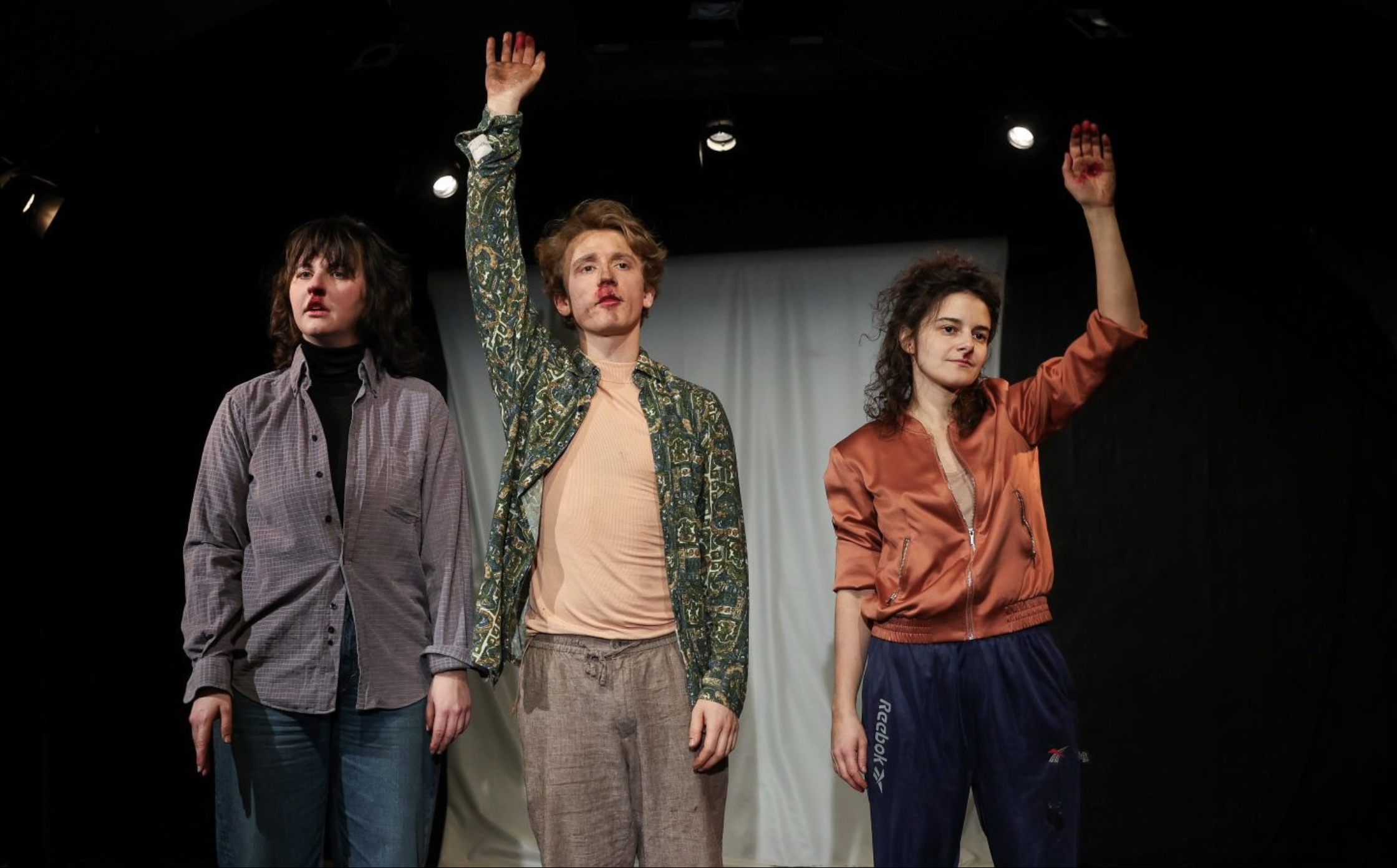
© Barbara Pálffy
(Sophie, Moritz, and Mila squeeze in together so everyone fits on screen)
Bohema: Wow, I didn't expect to see all of you for this interview!
Moritz: We're tied together, inseparable. (all laugh)
B: So, how did this production start off?
Sophie: We all met in Bern, where we were doing a master’s degree in experimental theatre and performance. People from very different backgrounds and genres came together there. Toward the end of the programme, we felt that we couldn’t leave without creating something together, whatever it might be. Because I live in Vienna, we started looking into this competition, and that’s how the project began. Many of our ideas developed outdoors, in gardens, and one day we came across this compost box filled with worms.
Moritz: We never worked together before. During the competition taking place last year, a lot of effort went into finding a language together because we function very differently. We come from very different backgrounds, to find a way together was a big challenge in the beginning.
Mila: And it still is sometimes.
B: The theme of disgust is very present in the performance, at least for me. What is your collective or personal relationship to it?
Mila: In projects like this, which have a certain level of absurdity, people always see different things and make associations on their own. Disgust was, in the beginning of this project, quite present from my side. During this time, I realized I'm disgusted by many things (laughs). And somehow, disgust was woven into the script. Many things in the script are personal but digested through our three made-up characters.
Sophie: I think it's inherent in all these topics. I mean, we talk for an hour about shit, and that itself is just very disgusting. Another thing we talk about is compost, which has this distinctive smell, and a worm on your skin can be very nice, but it can also be very disgusting. Being close can also be quite disgusting with all that bacteria, you know.
Mila: I think strong feelings like disgust actually provoke a lot of thought and discussion. The topics that usually seem the most disgusting are actually the ones that are the most interesting. So, there is definitely this paradox of being disgusted and also interested.
Moritz: It is also different if you come to this play as part of the audience and you're confronted with it. But since we work with it daily and we're so used to the topics it is different. We pluck the things apart, we mix shit with earth. I think through this process these topics fall apart, and for me the disgust also falls apart.
Mila: Moritz is somehow never disgusted. (all laugh)
Moritz: Maybe less than you are. But if you hear “shit transplant” for the first time, you cannot be not disgusted. But now that we’ve talked about it so often, it's just a funny thing now.
B: Was there a moment during rehearsals where you just thought, this is too much, we've gone too far?
Sophie: I think we still search for this feeling. Sometimes I surely ask myself, how far can we go? But more in relation to working together. There are for sure moments when none of us knows what comes next. Working with other people, thinking together, it is very intense.
Moritz: The feedback we got after the first version of the play was that we could go further and could be more extreme. So, we've been looking for places that feel uncomfortable, while also maintaining playfulness.
Mila: A big topic that we are trying to untangle is power dynamics and violence. We talked a lot about what violence can be, physical, emotional or intellectual, and what it means to have power over someone. And since our method of working is also very improvisational, there are sometimes moments when it feels a bit too much.
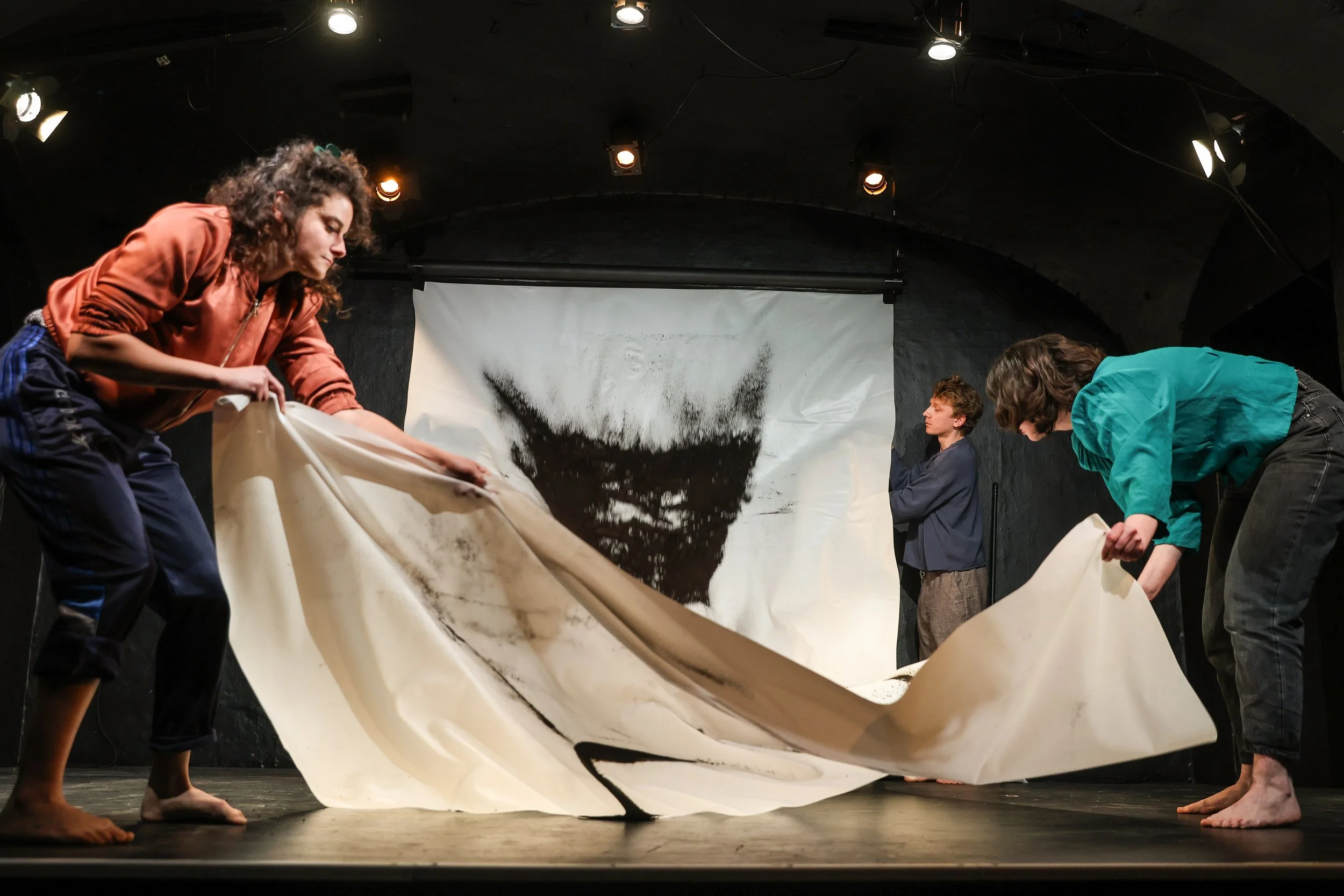
© Barbara Pálffy
B: Would you say the piece is political, or does politics just happen alongside the work?
Moritz: I’d say we are actively looking for it. It's not our main aim to make the play political, but we talk a lot about living together, how we deal with our bodies, and how we deal with bodies within a country. So, the political is there, but we try not to be didactic or give any answers.
Mila: Nowadays, the personal and the political are very merged. I feel like there’s nothing about my own body that is not political. Politics are so woven into our everyday lives that it is inevitably digested in the work, and sometimes it also emerges without looking for it.
Sophie: It's this inside and outside world we are working with, and they are in constant movement. But this happens without overthinking it… well, but sometimes we do overthink. (laughs)
Moritz: Otherwise we would just be a funny shit show. (all laugh)
B: Were there any insights during the creation process that genuinely surprised you?
Sophie: I think for me there was one moment when I realized I really liked them (all laugh), and they really like me. It takes a certain level of trust, so I can freely work as an artist, and it takes courage to trust others as well. And this was a very, very important moment, because this is not easy to find and it's not something I take for granted. But this surely influences how we work together.
Moritz: In the beginning, I wasn’t sure if we were supposed to bring a lot of the dynamics that happen between us onto the stage. But we did bring them, especially in the shorter version of the play it was inevitable since Mila and I were living on Sophie’s kitchen floor. What you see on stage is a lot of fighting on some level, but underneath there is trust. In the beginning there were a lot of doubts, such as: do we manage to really understand each other, or is this just a horrible project with three people who really have different opinions? Now we still keep fighting a lot, but there is never an existential fear that it cannot work out.
Mila: But we also learned a lot of interesting facts.
Moritz: Yeah, a lot of them.
Mila: Did you know that worms have ten hearts? I was amazed. And if you cut a worm, it grows an ass on the side that is cut. So, a worm can have two asses.
Sophie: I mean, content-wise it was really interesting, for example the topic of the shit transplant. When we told people, we were including this topic in our play, they were like, “yeah, I heard about that”. And we were genuinely surprised that everybody seemed to know about shit transplants already.
Moritz: One person also said, “yeah, I've been thinking about that”. (all laugh)
B: Since the piece won the competition, what makes this production stand out?
Sophie: In the competition, every piece was very different. I think somehow, we managed to accomplish something interesting with language. I think it was a matter of taste and luck that we won.
Mila: What might be interesting from the outside is the kind of digestion process the work goes through, the way images, words, and the dynamics between three people intertwine into something very cohesive and wholesome. It feels like a flow emerging from very different elements, and that is something both rare and difficult to achieve.
Sophie: But this is a constant struggle.
Moritz: I’m not sure whether our play really stands out. The feeling we created can also be achieved in other productions. But because we created it together, directed it together, and are all performing on stage as well, we genuinely enjoy playing together. I have the sense that the audience can feel this authenticity. When three friends are having a great time on stage, that dynamic becomes very present. We rely heavily on this shared energy and on the fun we have, without it, the whole thing would fall apart.
Sophie: I think what really connects us, if everything falls apart, is the humor. Humor releases a lot of things, and I think it can help to talk about difficult things when you don't really know how to talk about them. Humor enables us, and this is something we search for.
Mila: Yes, and the characters themselves come from a very personal place. Many of them emerge from our own experiences. In this piece, the characters don’t have names and they don’t have fixed traits. They take shape only through the dynamics between us and through the stories that are told. In that sense, they could be anyone. I think this also creates a specific way of looking at a body, at a human being, without a name, without predefined identities.
B: Who is this piece not made for, who should not come?
Sophie: I think everybody should come, and everybody is invited to like it or not like it.
Mila: There is also an ambivalence to it. We’ve talked a lot about the idea that we don’t all have to like each other; in fact, it’s impossible that everyone does. And that’s okay. What matters is respect and the ability to live together. This is more or less what we’ve agreed we want to convey. In that sense, it’s also valid if people don’t like the show. As Sophie said, it doesn’t have to be your piece of cake. What I’m striving for is not whether something is liked or disliked, but whether it opens up a space for discussion.
Moritz: Although if you're into classical psychological drama, you might have a hard time.
Mila: You might have.
Moritz: Because there are three people on stage talking to each other, but there is no thinking happening. (all laugh)
Sophie: I feel like it really helps to talk about the play.
Mila: You're helping us out! (all laugh)
B: Well, thank you guys so much. See you at the premiere, I’m really excited and will definitely be there!
Mila: This interview really helped us reflect on the whole process. Devising work is very specific: you start with almost nothing, just an idea. From there, everything is created collectively and horizontally. We generate the material together, write it, make decisions, rehearse it, step back to look at it from the outside, and then perform it. This way of working requires a lot of energy, not only for the creative process itself, but also to maintain healthy group dynamics and to learn how to make decisions together. It’s quite challenging.
Moritz: The competition last year, where we presented the shorter version, really helped us find a common style, or at least the beginning of one. If we had to go through all the personal dynamics we experienced in that first version again now, it would be much more difficult. That phase functioned as a kind of test run. Playing the piece over and over again gave us the experience of being on stage together, of learning how to work with each other in performance, and that was really…
Mila: …something to believe in. (all laugh)
Sophie: We kind of fell in love friendship-wise. But of course, also artistically. I might not like everything about the play, but I like a lot.